Take it forward yourselves.
Your team uses the detailed deliverables and roadmap to plan and deliver the changes. You own the work, with no obligation to continue with us.
Good people lose too much of their week to work a system should be doing.
We find what’s holding your operations back, put a number on it, and build what moves you forward.
Spreadsheets, email and people remembering things. They got the business this far. Now they’re getting in the way.
The same data, typed into two systems.
↗Approvals buried in a WhatsApp thread.
↗Month-end held together by one person’s spreadsheet.
↗The goal is to give your people their time back.
Less repeat. More judgement.Before choosing software, find out what’s worth fixing. Our Systems Diagnostic turns a difficult process into a decision you can make.
The business case and prototype are yours, whether we build the next part or someone else does.
Follow one process from start to finish, including the workarounds. Draw how it really runs, not how the org chart says it should.
A clear process mapIdentify repeated entry, waiting, knowledge held in someone’s head and errors fixed later. Use your volumes and costs to put a value on the work.
A measured starting pointDecide whether the problem needs better data, integration, automation or human judgement. Use AI only where the task and the checks make sense.
A practical recommendationCompare the cost to fix each problem with the value it can return. Agree the starting figures and name the person who owns each result.
Priorities with owners and paybackPrototype the first worthwhile change. Set out what to build, in what order, and how later improvements can reuse the foundations.
A working prototype and delivery roadmapOur rule for what goes first:
It must pay back inside twelve months.
A Malaysian jobs platform needed a better WhatsApp assistant. The most useful finding turned out to be beyond the bot.
We rebuilt a menu-based chatbot into a natural-language assistant in Bahasa Malaysia, English and Chinese. Sign-up completion rose. Re-engagement improved.
But the data showed that 87% of people reaching the client’s application form were dropping off there. We reported it — even though that form was outside our scope.
Sign-up completion increased from 76% to 84%. The re-engagement programme saw 153 of 399 people return to chat: 38%, compared with 0% in an un-nudged control group.
314 automated tests supported a reversible production cut-over. These figures are from the July 2026 performance review; the client is anonymised.
A clearer path from conversation to completion.
People who returned to the conversation.
Checks supporting a careful, reversible production cut-over.
We can build any one of these, combine a few, or connect them to systems you already have. Start with the gap that matters; add the next piece when it earns its place.
Build a shared operational record and connect it to existing tools, so the same information can move between them.
Already have a strong foundation? We can build on it. A customer portal or agent does not require you to rebuild every system underneath it.
These are the systems we run every day. They keep our thinking close to the reality of building, using and maintaining software.
Idea Forge researches companies and markets, proposes opportunities and scopes the work. We review the judgement, rather than start from a blank page.
Actual product screen · sensitive details redacted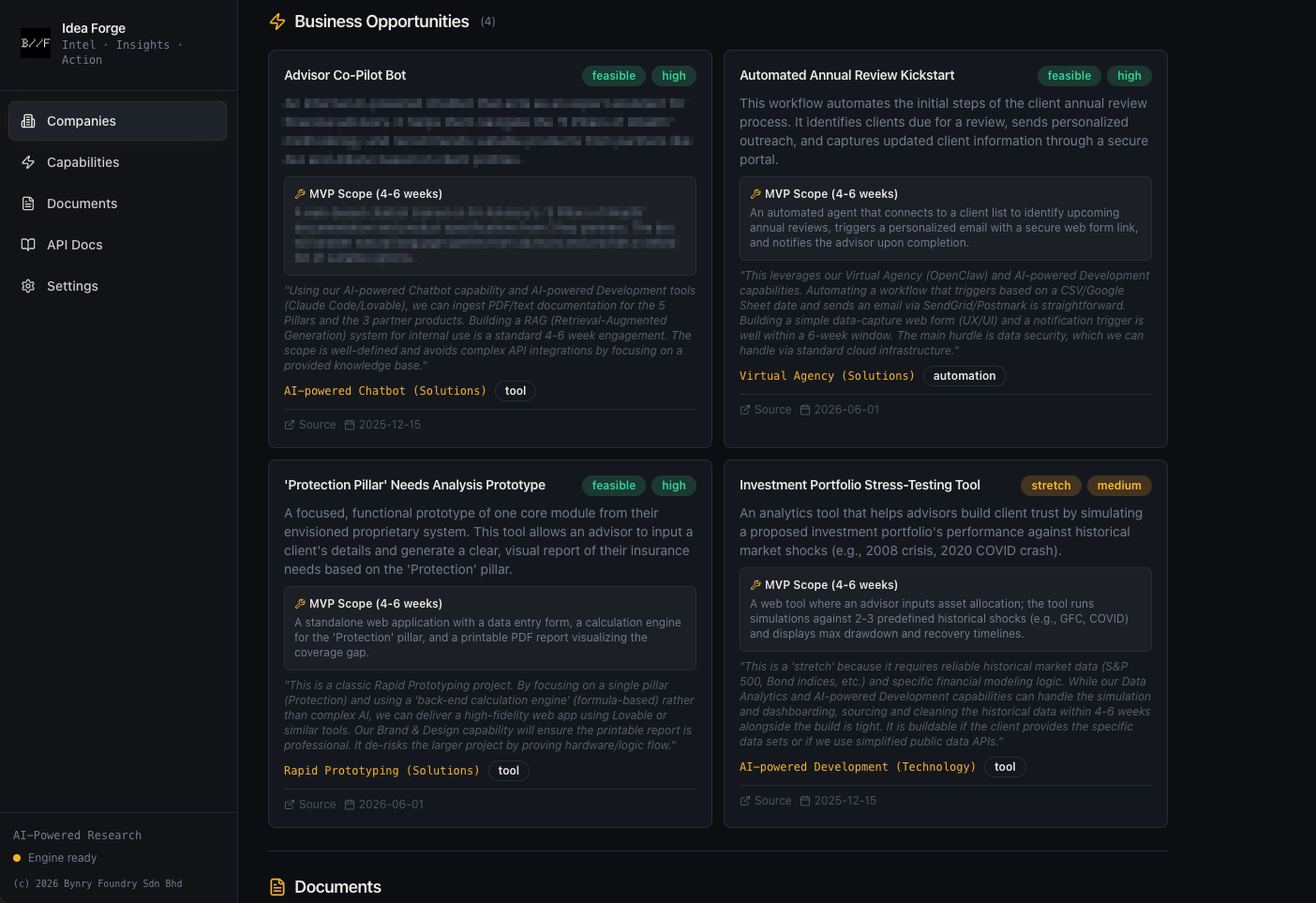
We look for the work that delays customers, consumes effort or hides value. Here’s where we would start the conversation in four sectors.
Onboarding and review often repeat the same checks across several systems. Make the information reusable and the exceptions visible.
Repeated document requests, re-keyed customer details and reviews that start from scratch.
Connect the customer record, automate routine document checks and give reviewers a clear exception queue.
Time to onboard, manual touches per case and applications completed.
How often do we ask a customer for information we already hold?
Four disciplines. Senior experience across digital, commercial operations, innovation and marketing. Thinking stays with the people you meet.
Thirty years across telco, fintech and digital. Former Head of Digital at Maxis, with 100% year-on-year e-commerce growth and mobile apps exceeding 70% of mobile internet revenue.
Two decades across telco, insurance and fintech. Cut number-portability churn by 30% at Maxis. Knows enterprise implementations from the client’s side of the table.
Founding team of Malaysia’s national innovation agency and its first Design Thinking school. Upskilled over 200 people in under a year at kipleX.
Ideas on business, systems and AI from our ongoing journal.

The EU AI Act begins enforcement in August, revealing that many companies lack adequate governance. The focus is shifting from principles to demonstrable controls and accountability for…
Read the article ↗
Microsoft’s $2.2 billion investment in Malaysia highlights a critical gap in AI adoption, currently at 27%, compared to Singapore’s 48%. While infrastructure is advancing, many Malaysian…
Read the article ↗
AI investments surged to $242 billion last quarter, but a mere 2% yield meaningful returns, with an 85% failure rate reported by MIT. Common pitfalls include neglecting to establish…
Read the article ↗From the Bynry Foundry journal.
Bring the one that’s bothering you most. We’ll talk through how it works, where it gets stuck and whether it’s worth a closer look.
Let’s talk ↗[email protected]A good first conversation
starts with the work.